The university
$6.5 billion
in foreign money that universities left unreported until federal investigators came looking.
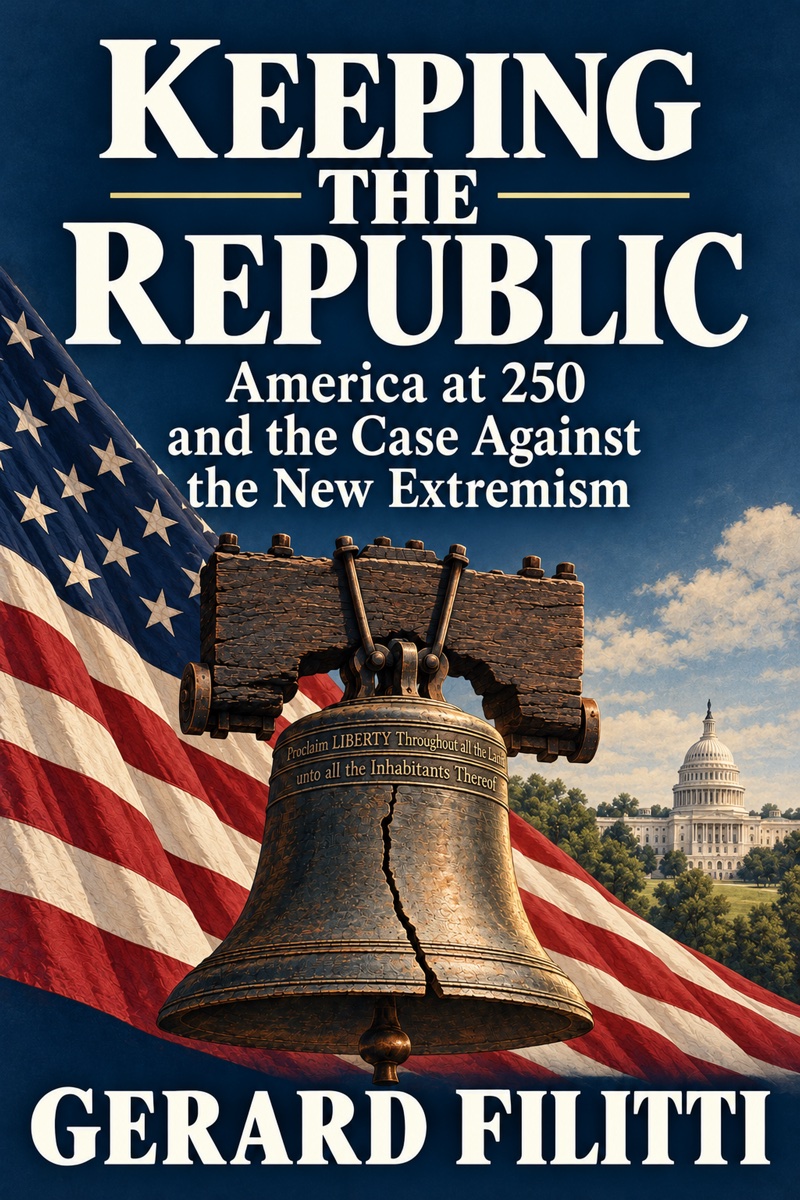
America at 250 and the Case Against the New Extremism
Order on Amazon
The book
On July 4, 2026, America turned 250. Whether Americans keep the republic for the next 250 years depends on what they decide, now, to accept as normal.
Not since Soviet communism has an ideology with global sponsorship, institutional depth, and open contempt for the American constitutional order gained this much ground inside the United States. In Keeping the Republic, civil rights lawyer Gerard Filitti names it: the oppressor-versus-oppressed ideology of Marxism grafted onto the revolutionary fervor of Islamism, engineered abroad in Paris, Tehran, and Moscow, and adopted here.
Gaza is its cover, not its cause.
“A republic, if you can keep it.”Benjamin Franklin · Philadelphia, September 17, 1787
Every generation of Americans since has been handed the same conditional sentence, and most of them have had to discover, each in their own emergency, what the condition actually demands.
Part II · The Attack
The university
$6.5 billion
in foreign money that universities left unreported until federal investigators came looking.
City Hall
$100 billion+
the budget now commanded by a democratic socialist mayor in America’s largest city.
The street
Hezbollah flags
outside synagogues in Manhattan and Brooklyn.
The courtroom
One year
in county jail for the killing of a 69-year-old Jewish man at a pro-Israel demonstration in California.
Contents
Part I
The creed of 1776, the constitutional machinery that binds every president, and the long line of Americans, from Frederick Douglass to Martin Luther King Jr., who enforced the founding against those who betrayed it.
Part II
The fusion traced from its founders abroad to the campus, the nonprofit, City Hall, and the sidewalk outside the synagogue.
Part III
A doctrine called denormalization; an arsenal of federal law most Americans have never heard of, from Title VI and the FACE Act to FARA and Section 117; and the civic rebuilding that has to follow enforcement.
Read an excerpt
It is a synagogue on the East Side of Manhattan. It needs no romanticizing - a building of stone and stained glass, one of hundreds like it in this city. What distinguishes it in the two hundred and fiftieth year of American independence is the steel: interlocking barriers along the sidewalk, a police detail posted at the doors on the Sabbath, and congregants who have learned - without anyone teaching them, which is how these lessons are always learned - to check the corner before they cross, to walk their children on the inside of the pavement, to treat the short distance between the curb and the sanctuary as terrain.
Here is the detail that should stop you: nobody thinks any of this is remarkable. Not the officers, who are professionals doing an assignment. Not the congregants, who have adjusted, because adjusting is what people do. Not the city, which has filed the whole arrangement under managed. A mob outside a synagogue is a scandal. But the routine of a mob outside a synagogue is a verdict - on the city, on the moment, and on how much erosion a free society has decided to call weather.
The standard of proof
Every factual claim rests on court records, government filings, sanctions designations, or the subject’s own published words.
Law can stop the poison, but only culture refills the vessel. The remedy runs on confidence: the same equal protection and equality before the law that carried the republic from 1776 to 250.
“For happily the Government of the United States, which gives to bigotry no sanction, to persecution no assistance, requires only that they who live under its protection should demean themselves as good citizens, in giving it on all occasions their effectual support.”
George Washington, to the Hebrew Congregation, 1790
What we normalize is what we become.
America has beaten a fusion ideology before. The republic reaches 350 the way it reached 250.
The republic is the client
Order on Amazon